
How to get up to speed at a new job
Last updated: October 23, 2026
A new job comes with new names, new projects and meetings that started long before you arrived. If you spend your first weeks feeling a step behind, you're in good company, and it passes faster when you work on it on purpose.
This guide covers a realistic ramp, mapping the people around you, your first month of meetings, and questions to ask when you're unsure. It's published by Hintly, a Chrome extension for Google Meet, which comes up near the end along with its limits.
Yes, feeling lost is normal
Gallup research found that only 12% of employees strongly agree their organization does a great job onboarding new employees. If your first week was a laptop, a login and a full calendar, that's the usual experience.
The vocabulary is a big part of it. In a 2023 LinkedIn and Duolingo survey of more than 1,000 US workers, more than half said they had to figure out workplace jargon on their own when they started their most recent job.
Feeling lost usually means you're missing context, not ability. You don't yet know the history, who decides what, or why things are done a certain way. Context is learnable, and most of it comes from people rather than documents.
What a realistic ramp looks like
Every role and company is different, so treat this as a common shape rather than a schedule.
Week 1: lots of input, little output
Accounts, tools, introductions and meetings where half the names mean nothing. Feeling slow is normal. Your job this week is to meet people and notice what keeps coming up.
Around week 4: patterns start to show
You recognize the recurring meetings, the main projects and the people who get asked about everything. You're still asking plenty of questions, but they're more specific. A good goal is one small piece of real work, finished and shared.
Around week 12: you have the context
You can follow most discussions, you know the story behind the big decisions, and your questions shift from "what is this?" to "is this the right approach?" Senior roles, complex products and a move into a new industry can stretch this out. That's expected, not a warning sign.
Map the people
Most of what you need to learn sits in people's heads: who owns which decision, who knows the history, who to ask when something breaks.
Keep a who's-who cheat sheet
Start one note or spreadsheet with a row for each person you meet. Four columns are enough:
| Name | Role | What they own | How you met |
|---|---|---|---|
| Sarah Kim | Head of finance | Budgets and the quarterly forecast | Intro call, week 1 |
| Daniel Ortiz | Senior engineer | The billing service | Sprint planning, week 1 |
| Mei Lin | Account manager | The two largest client accounts | Shadowed her client call, week 2 |
| Sam Okafor | Product lead | Pricing and the March launch | Coffee chat your manager set up |
"What they own" matters most, because it tells you who to ask. Add people as they come up in meetings, even before you've spoken to them.
Ask your manager for an org chart
Your company may have a formal chart in its HR system, but your manager's version is more useful. Ask: "Could you sketch out who I'll work with most, and who makes the calls on what?" Then follow up with: "Who are the five people I should meet in my first month?" Book short intro chats with each, and ask each one who else to meet.
Remember names
- Use it back straight away. "Good to meet you, Daniel." Saying a name out loud once helps it stick.
- Write it down within the hour, with one detail from the conversation.
- Test yourself, spread out. Cover the name column of your cheat sheet and recall each name from the role. Repeat later that day, the next day and at the end of the week. Pulling a name from memory works better than rereading a list.
- Ask again early. "Sorry, remind me of your name?" is easy in week one and awkward by week six, so ask while it's still easy.
Industry words vs company words
Two kinds of unfamiliar vocabulary need two different fixes. Industry words, like churn, underwriting or a SOC 2 audit, mean roughly the same thing at every company, so you can learn them on your own: search them, read a beginner's guide to the field, and skim a few industry newsletters or podcasts to hear how people use them. Company words, like project codenames, team nicknames and names for internal tools, aren't online at all, so only colleagues and internal docs can explain them. For a first-month plan that captures both in a glossary, see how to keep up with acronyms at work.
Your first month of meetings
You don't need to follow every detail of meetings that started before you joined. Three habits help:
- Listen for decisions and owners. After each meeting, write three lines: what was decided, who owns the next step, and what's still open. If you can answer those, you followed it.
- Ask one question per meeting. Use it on your biggest gap and save the rest for a message afterwards.
- Ask for context before the big ones. Before a planning meeting or a review, ask the organizer or a teammate: "Is there anything I should read or know before this?" Ten minutes of reading beats an hour of guessing.
It's fine to say little in your first few weeks. People expect you to be learning.
Prepping for client calls and unfamiliar topics
Client calls and meetings outside your area are where feeling lost shows most. Fifteen minutes of prep covers most of it:
- Read the invite, the agenda and any linked doc.
- Look up the client: what they do, any recent news, and the roles of the people attending.
- Ask whoever owns the relationship: "Anything I should know before this call, or anything to avoid bringing up?"
- Look up two or three terms you expect to hear.
Questions that don't make you look lost
A good question shows what you already understand and asks for the missing piece. These work in meetings, one-on-ones and messages:
- "What's the history here? I'd like to understand how the team got to this decision."
- "Who's the best person to ask about the billing migration?"
- "So the plan is to launch in March, and Sam owns pricing. Have I got that right?"
- "What would good look like for this by the end of the month?"
- "Is there a doc or an old thread I should read first?"
- "I'm still building context on this project. Could you give me the two-minute version?"
The third one, a summary phrased as a check, is the most useful habit to build. It shows you were listening, and if you've got something wrong, you find out now rather than next week. For asking about a specific term in the middle of a call, see how to understand jargon in meetings.
When feeling lost is a signal to talk to your manager
Some confusion is part of starting. These signs suggest something needs to change, and your manager is the person who can change it:
- You don't know what you're expected to deliver, or what success looks like in three months.
- Different people are giving you instructions that conflict.
- You've been blocked for days waiting on access, a decision or a person.
- Several weeks in, things aren't getting clearer, or you've started dreading work.
Bring it as a request, not a confession. Say what you think is true and ask them to correct it:
- "I'm four weeks in and want to check I'm focused on the right things. I think my priorities are the pricing page and the onboarding emails. Is that right?"
- "Sam and Sarah have given me different launch dates. Which one should I plan around?"
If you don't have a regular one-on-one yet, ask for one.
Where Hintly helps on Meet calls
Hintly is the Chrome extension this site is for. Switch it on from the toggle beside Meet's Leave call button and it reads the call's live captions. When an industry term, a lesser-known company or a notable person comes up, a small card appears near the top of the Meet tab a moment later with a short explanation, so you can keep listening instead of searching.
It also keeps track of the people, projects and clients mentioned during the call. When one comes up again, a card reminds you who or what it is, which helps in the weeks when every name is new.
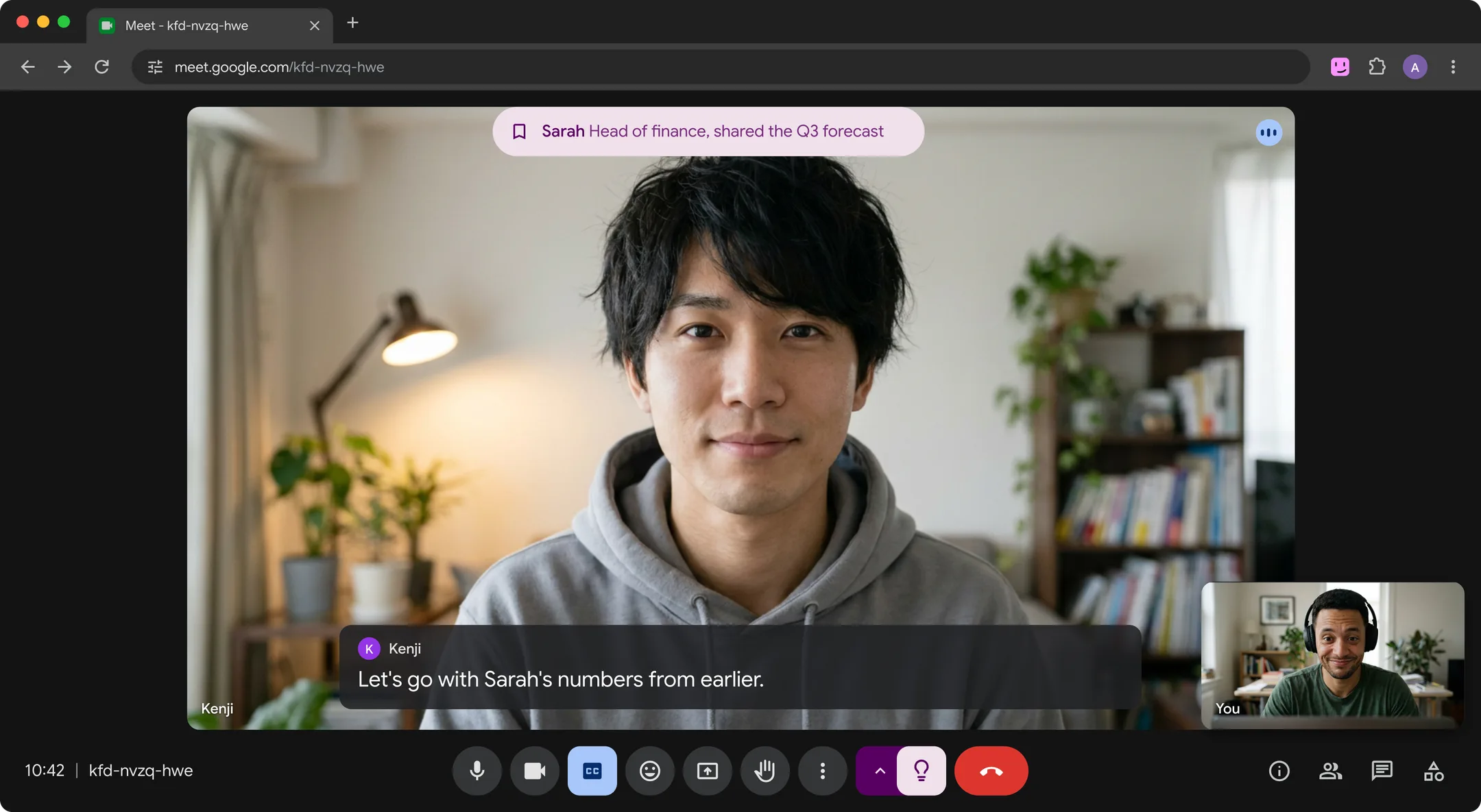
When someone asks you to do something, a "For you" card shows the ask, so it doesn't slip past while you're still working out who's who. The cards appear only on your screen, no bot joins the call, and nothing is recorded. If you share your entire screen, or a window showing the cards, others can see them too. Your first 60 minutes of call time are free, then Pro is $12 a month for 50 hours of calls.
What it won't do:
- Know your internal codenames. Project names and team shorthand stay unexplained unless someone on the call spells them out.
- Remember people after the call. Memory clears when the call ends, so your cheat sheet is still where names live.
- Take notes. It doesn't save transcripts, summaries or action-item lists. For those, see Google Meet AI assistants.
- Work outside Google Meet. It runs on Meet calls in desktop Chrome only, so Zoom, Teams and in-person meetings aren't covered.
- Translate. It's built for calls in English.
- Always be right. Hints are written by AI and can be wrong, so check anything you're about to act on.
Caption text is sent to Hintly's server and AI models to write the hints, and the server doesn't store it. What your colleagues say is part of that text, so check your organization's policy on AI tools before using it on work calls.
FAQ
Is it normal to feel lost at a new job?
Yes. You're joining conversations, projects and relationships that were already under way, and onboarding rarely covers all of it: in Gallup's research, only 12% of employees strongly agree their organization does a great job onboarding. It usually eases as you learn who owns what. If it isn't easing after several weeks, raise it with your manager.
How long does it take to get up to speed at a new job?
A common pattern is that the first month is mostly learning, things start to click somewhere in the second or third month, and senior or highly technical roles take longer. Changing industries adds time, because you're learning the field's vocabulary as well as the company's. Ask your manager what they expect from you by 30, 60 and 90 days, so you're measuring yourself against their timeline.
How do I remember everyone's names?
Say each name back when you're introduced, write it down with their role and one detail, and test yourself from your notes a few times over the following days rather than rereading them. If you forget a name, ask early. It only gets harder the longer you wait.