
AI terms explained in plain English
Last updated: October 23, 2026
AI comes up in more meetings every month, and the vocabulary moves fast. This glossary explains the AI terms you're most likely to hear at work in plain English, with an example of how each one sounds on a call.
It's for anyone in those meetings who isn't a machine learning engineer: product managers, designers, marketers, sales and founders. Jump to a section below, or search the page for the word you just heard. This page is published by Hintly, a Chrome extension for Google Meet. These are the kind of terms it usually explains live on a call, and a section near the end lists the everyday words it skips.
Jump to:
- Models and how they work
- Building with AI
- Agents and tools
- Quality and safety
- Cost and performance
- Slang you'll hear
- Everyday AI words Hintly skips
- Get AI terms explained during a call
- FAQ
Models and how they work
What the models are, what they read and how they differ.
LLM (large language model)
A type of AI model trained on huge amounts of text to predict what comes next, one token at a time. That turns out to be enough to write, summarize, translate and code. The models behind ChatGPT, Claude and Gemini are LLMs.
On a call: "Are they training their own LLM, or just calling one through an API?"
Token
The unit of text a model reads and writes. A token can be a whole word, part of a word or a punctuation mark. In English a token is often about three-quarters of a word, but the ratio varies by model and language. Usage limits and API prices are usually counted in tokens.
On a call: "That prompt costs about 8,000 tokens per request, so let's trim it."
Context window
The maximum amount of text a model can take into account at once, measured in tokens. It covers everything in the request: instructions, the conversation so far, any documents you paste in, and the model's own reply.
On a call: "The whole contract fits in the context window, so there's no need for RAG here."
Foundation model
A large model trained on broad data that can be adapted to many different tasks, rather than built for one job. The term was introduced in a 2021 Stanford paper. LLMs are foundation models, and so are many image, audio and video models.
On a call: "Building on a foundation model gets the pilot out in weeks, not months."
Frontier model
One of the most capable general-purpose models available at a given time, usually from the few labs with the most computing power. It's a moving line: today's frontier model is a mid-range one a year or two later.
On a call: "This step needs a frontier model. The small one keeps missing edge cases."
Reasoning model
A model trained to work through a problem in intermediate steps, often called thinking, before it gives a final answer. Answers are slower and cost more, but are usually better at math, code and multi-step logic. OpenAI's o1, first released as a preview in September 2024, brought the idea into wide use.
On a call: "Route the tax questions to a reasoning model. They're logic problems, not writing ones."
Multimodal
Able to work with more than one kind of input or output, such as text, images, audio and video. A multimodal model can read a screenshot, describe a chart or answer a spoken question.
On a call: "The model's multimodal, so users can just upload a photo of the receipt."
Open-weight model
A model whose trained weights, the numbers that make up the model, are published for anyone to download and run. That's not the same as open source. The Open Source Initiative points out that open weights usually come without the training code and data needed to fully study or rebuild the model.
On a call: "With an open-weight model, customer data never has to leave the company's servers."
Temperature
A setting that controls how random a model's output is. A low temperature makes answers more predictable and consistent, and a higher one makes them more varied. Low settings suit data extraction, higher ones suit brainstorming.
On a call: "Turn the temperature down. It's inventing a new format every run."
Building with AI
Terms from teams putting AI into a product.
System prompt
Instructions a developer gives the model before any user message, setting its role, rules and tone. People using the app usually don't see it. It typically says what the assistant is for, what it must never do and how to format answers.
On a call: "Put the refund policy in the system prompt so it stops making one up."
RAG (retrieval-augmented generation)
A technique where the system first searches a set of documents for passages related to the question, then gives those passages to the model to write its answer from. In simple terms: look it up, then answer. It lets a model use your company's own, up-to-date information without retraining it.
On a call: "The assistant is answering from last year's docs, so the RAG index needs a refresh."
Grounding
In Google's words, the ability to connect model output to verifiable sources of information, such as search results, a database or documents you provide, so the model isn't relying only on what it learned in training. Grounded answers often come with citations. RAG is one common way to ground a model.
On a call: "Can the answers be grounded in the help center, with a link to the article it used?"
Embedding
A list of numbers that represents the meaning of a piece of text, an image or another item. Items with similar meanings get similar numbers, so software can find related content by comparing them, even when the words don't match. Most RAG systems rely on them.
On a call: "Every ticket gets an embedding, so 'can't log in' also finds the password reset tickets."
Vector database
A database built to store embeddings and quickly find the ones closest to a query. It's the search layer in many RAG systems. Some teams use a dedicated product, others add vector search to a database they already run.
On a call: "Does this need a separate vector database, or can Postgres handle it?"
Fine-tuning
Further training an existing model on a smaller set of your own examples, so it gets better at a specific task, style or format. Unlike a prompt or RAG, it changes the model itself. Teams usually try it after better prompts and RAG have fallen short.
On a call: "Before anyone fine-tunes, try better examples in the prompt."
Agents and tools
The vocabulary of AI that takes actions, not just writes replies.
AI agent
A system where an AI model works toward a goal over several steps, deciding for itself which actions to take and which tools to use, such as searching, running code or updating a record. It checks each result and keeps going until the task is done or it needs a person. A chatbot answers; an agent acts.
On a call: "The agent opens the ticket, checks the logs and drafts a fix before anyone looks at it."
Agentic
Describes AI that acts with some independence instead of giving a single response: planning steps, calling tools and checking its own work. It's a spectrum, and also a popular marketing word, so it's fair to ask what a product actually does without a person approving each step.
On a call: "Every vendor says 'agentic' now. What does theirs actually do without approval?"
Agent harness
A newer term for the software around a model that turns it into a working agent. It runs the loop: calling the model, carrying out the tools it asks for, feeding results back, managing the context window and enforcing permissions. Anthropic, for example, describes its Claude Agent SDK as a general-purpose agent harness. Usage is still settling, and some people use it loosely for any agent framework.
On a call: "Same model, new harness, and the success rate on the coding tasks doubled."
MCP (Model Context Protocol)
An open standard for connecting AI apps to outside tools and data, such as files, a calendar or a company database. Anthropic introduced it in November 2024, and many AI apps and developer tools have since added support. A service built once as an "MCP server" can then work with any AI app that supports the protocol, instead of needing a separate integration for each.
On a call: "Ship an MCP server and customers can plug the data into whatever AI tool they use."
Human in the loop
A design where a person reviews, corrects or approves an AI system's work at key points before it takes effect, such as before an email is sent or a refund is issued. It trades some speed for safety and accountability.
On a call: "Keep a human in the loop for anything that touches billing."
Quality and safety
How teams talk about AI getting things wrong.
Hallucination
When a model states something false or made up as if it were fact, such as a citation that doesn't exist or a wrong figure. It happens because models generate plausible text rather than looking facts up, unless they're grounded in a source.
On a call: "It hallucinated a court case, so legal wants every citation checked by hand."
Evals
Short for evaluations: repeatable tests that measure how well a model or AI feature does on a set of example tasks. Think of them as unit tests for AI, usually scored rather than pass or fail. Teams run evals before switching models or changing a prompt, to check nothing got worse.
On a call: "Don't swap models until the evals have run."
LLM-as-a-judge
Using one LLM to grade another model's outputs against a rubric, for example rating answers for accuracy or tone. It's far cheaper than human review at scale. Strong models can agree with human raters about as often as humans agree with each other, but judges have biases, so teams still spot-check them.
On a call: "An LLM-as-a-judge scores the nightly run, and someone reviews a sample by hand each week."
Guardrails
Rules and checks around an AI system that limit what goes in and what comes out, for example blocking personal data, refusing off-topic requests or checking that output matches a required format.
On a call: "It needs guardrails so it never quotes a price that isn't in the catalog."
Prompt injection
An attack where text written to look like instructions gets a model to ignore its original rules. It can be direct, typed by a user, or indirect, hidden in a web page, email or file the AI reads. It's a bigger risk for agents, because a hijacked agent can take actions, not just say the wrong thing.
On a call: "What stops a prompt injection hidden in an email from making the agent forward the whole inbox?"
Red teaming
Deliberately attacking or probing an AI system the way an adversary would, to find harmful outputs, security holes or failure cases before release. The name comes from military and security exercises where a "red team" plays the opponent.
On a call: "Security wants a week to red team the assistant before launch."
Cost and performance
For when talk turns to speed, hardware and the bill.
Inference
Running a trained model to get an output, as opposed to training it. Every time someone sends a prompt and gets a response, that's inference. In budget talk, "inference costs" means the ongoing bill for serving a model to users.
On a call: "Training was a one-off. Inference is the line item that grows with every user."
Test-time compute
The computing power a model uses while answering, rather than in training. Letting it reason for longer, or try several answers and pick the best, tends to improve results on hard problems. When OpenAI released o1, it reported better results the more time the model spent thinking. The trade-off is slower, more expensive answers.
On a call: "More test-time compute buys accuracy, but each answer takes twice as long."
Distillation
Training a smaller "student" model to imitate a larger "teacher" model's outputs, so it keeps much of the quality while being cheaper and faster to run.
On a call: "Could the big model be distilled into something small enough to run on the phone?"
Quantization
Storing a model's numbers with less precision, for example 8 or 4 bits each instead of 16, so it needs less memory and runs faster. The cost is a drop in quality, usually small. It's a common way to run large models on laptops or cheaper hardware.
On a call: "The 4-bit quantized version fits on one GPU, and nobody could tell the difference in testing."
Mixture of experts (MoE)
A model design that splits parts of the network into many smaller "expert" sub-networks, with a router that sends each token to only a few of them. The model can be huge in total but uses only a fraction of its parameters per token, so it costs less to run than a same-size model that uses everything. Despite the name, the experts aren't topic specialists; the split is learned in training.
On a call: "It's an MoE, so it's huge on paper, but only a slice of it runs per token."
Slang you'll hear
Informal terms that started online and moved into meeting rooms.
Vibe coding
Building software by describing what you want to an AI and accepting the code it writes without reading it closely. AI researcher Andrej Karpathy coined the term in February 2025, describing it as fully giving in to the vibes and forgetting the code even exists. It's now used loosely for any heavily AI-assisted coding, as praise or as a warning.
On a call: "The prototype was vibe coded over a weekend, so nobody has reviewed the code yet."
AI wrapper
A product built mainly on top of another company's AI model, adding an interface, prompts or integrations rather than a model of its own. It's often said dismissively, implying the product is easy to copy. Most AI apps call someone else's model, so the real question is how much the product adds.
On a call: "Investors will ask why this isn't just a wrapper."
Everyday AI words Hintly skips
Hintly stays quiet for words most adults already know, so a card doesn't pop up every time someone says "AI". These usually don't get a hint:
- AI: artificial intelligence, software that does tasks that usually take human thinking.
- ChatGPT: OpenAI's AI chat app.
- Chatbot: software you talk to by typing or speaking, which replies in conversation.
- Prompt: the instruction or question you give an AI model.
- Algorithm: a set of steps a computer follows to solve a problem.
Get AI terms explained during a call
The term that loses you is usually the one you didn't expect. Hintly is a Chrome extension for Google Meet in desktop Chrome. Switch on its toggle beside the Leave call button, and it reads the call's live captions and shows a small card near the top of the Meet tab a moment after a term comes up: the term and a short explanation, with more when you hover.
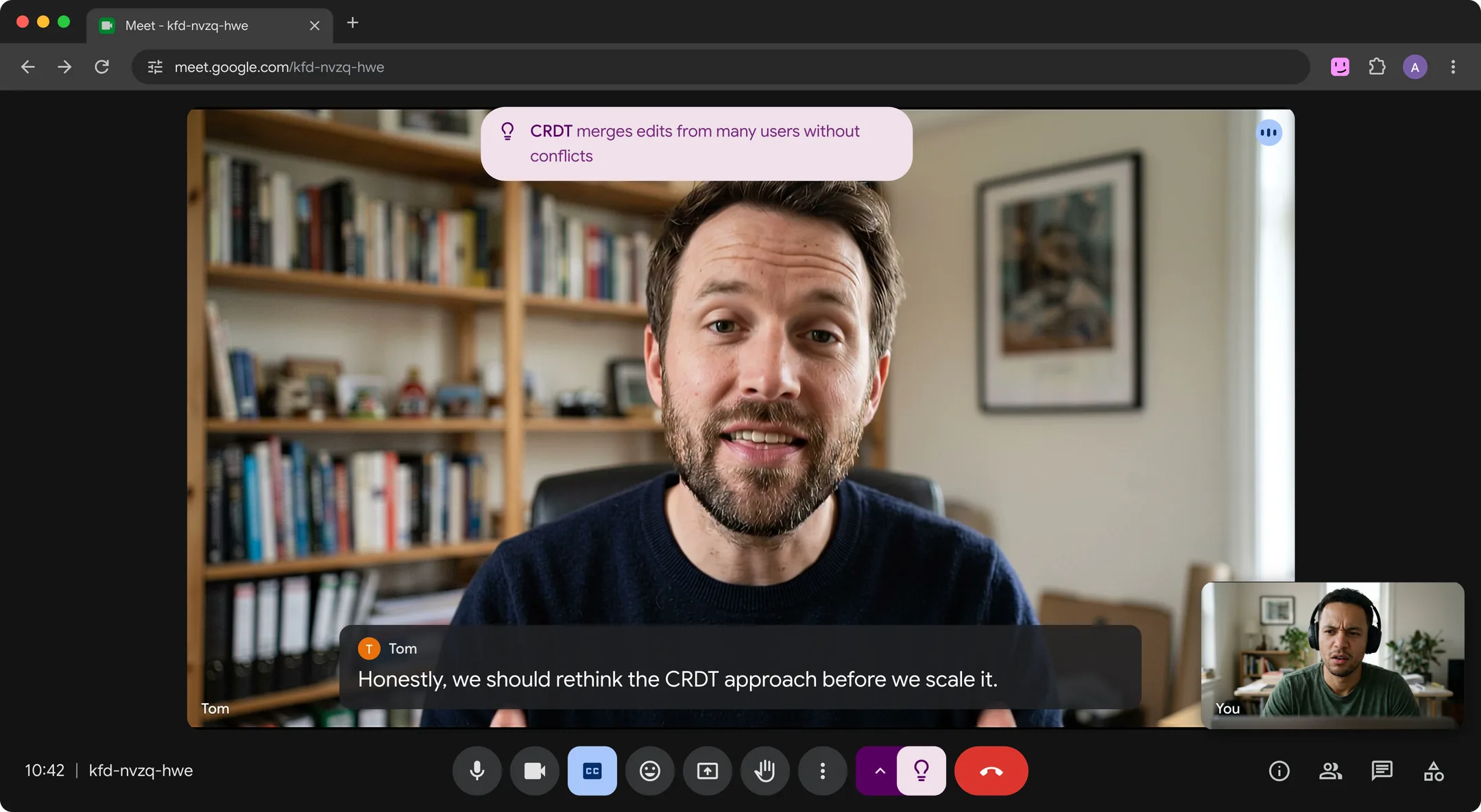
Cards also show in Meet's Picture-in-Picture window, so they follow you if you switch tabs. They appear only on your screen. If you share your entire screen, or a window showing the cards, others can see them too. No bot joins the call, nothing is recorded, and Hintly's server doesn't store what's said. Your first 60 minutes of call time are free, and Pro is $12 a month for 50 hours of calls.
Where it falls short:
- Google Meet only, in desktop Chrome. Not Zoom, Teams, phone calls or in-person meetings.
- Built for calls in English. It doesn't translate.
- It skips the basics, like the everyday words above, and it won't know your team's internal codenames unless someone on the call explains them.
- Hints are written by AI and can be wrong. If a term feeds into a decision, confirm it.
To write hints, caption text from the call is sent to Hintly's server and AI models, so check your organization's policy on AI tools first. For other ways to handle unfamiliar terms, see how to understand jargon in meetings. For technical calls, see the software engineering terms glossary.
FAQ
What's the difference between AI, machine learning and an LLM?
They're nested. AI is the broad goal of getting computers to do tasks that normally take human intelligence, including older rule-based systems. Machine learning is the part of AI where systems learn patterns from data instead of following hand-written rules. An LLM is one kind of machine learning model, trained on huge amounts of text to understand and generate language. Every LLM is machine learning, and all machine learning is AI, but not the other way round.
What's the difference between a foundation model and a frontier model?
A foundation model is defined by how it's built and used: trained on broad data, then adapted to many tasks. A frontier model is defined by where it ranks: among the most capable models available right now. The UK government, for example, has described frontier AI as highly capable general-purpose models that match or exceed today's most advanced models. Frontier models are foundation models, but most foundation models aren't at the frontier, and today's frontier won't be next year's.
What does "agentic" mean?
It describes AI that works toward a goal over several steps instead of giving one reply: planning, using tools, checking results and trying again. Some systems follow fixed steps a developer wrote; others let the model decide the steps itself, which is what most people mean by an agent. When a product is called agentic, ask what it does on its own and where a person still approves.