
Startup and VC terms explained in plain English
Last updated: October 23, 2026
Startup calls run on jargon. This glossary is for people joining a startup, vendors selling to one, people moving over from corporate jobs and first-time founders. Each term gets a plain definition and an example of how it sounds in a meeting.
These are the kind of terms Hintly, a Chrome extension for Google Meet, usually explains live during calls. Near the end, there's a short list of everyday words it skips.
This is general information, not legal or financial advice. Terms vary by deal and by country, and many here are US-specific.
Jump to:
- Fundraising and rounds
- Ownership and equity
- Investors and funds
- Running the company
- SaaS metrics
- Valley slang
- Everyday words Hintly skips
- Get startup terms explained during a call
- FAQ
Fundraising and rounds
Startup funding terms, from the first check to a Series A.
Priced round
A round where investors buy shares at a set price per share, which fixes the company's valuation. Series A, B and C rounds are usually priced and use preferred stock. SAFEs and convertible notes put off setting a price.
On a call: "The SAFEs convert when the priced round closes."
Term sheet
A short summary of an investment's main terms: the amount, valuation, type of shares, board seats and investor rights. Most of it isn't legally binding, though confidentiality and exclusivity ("no-shop") clauses usually are.
On a call: "The term sheet came in last night, with a 30-day no-shop."
Lead investor
The investor who sets a round's terms, usually writes the largest check and often takes a board seat. Others join on the same terms, and rounds often stall until a lead commits.
On a call: "Two funds are interested, but neither will commit without a lead."
Pre-money and post-money valuation
Pre-money is the company's valuation just before new money comes in. Post-money is the pre-money plus the new money. Raise $2 million at an $8 million pre-money and the post-money is $10 million, so the new investors own 20%.
On a call: "Is that twenty million pre-money or post-money?"
SAFE (simple agreement for future equity)
An investment contract created at Y Combinator in 2013. The investor pays now and gets shares later, usually at the next priced round. Since 2018, YC's standard is the post-money SAFE, where ownership is simply the investment divided by the post-money cap: $1 million on a $10 million cap buys about 10%, before the priced round dilutes everyone.
On a call: "Most of the seed came in on post-money SAFEs."
Valuation cap
The highest valuation at which a SAFE or convertible note turns into shares. If the priced round comes in above the cap, early investors convert at the cap's lower price and get more shares for their money.
On a call: "The angels are on a twelve million cap, well below the Series A price."
Discount
A term that lets early money convert at a lower price than new investors pay. With a 20% discount and a Series A price of $1.00 a share, the SAFE or note converts at $0.80. When a note has both a cap and a discount, the investor usually gets whichever price is lower.
On a call: "The note has a cap and a 20% discount, whichever is better for them."
Convertible note
Short-term debt that converts into shares at a later priced round, usually with a cap, a discount or both. Unlike a SAFE, it has an interest rate and a maturity date.
On a call: "The notes mature in March, so the round has to close first."
Bridge round
A smaller raise to carry the company to its next milestone, big round or sale, often from existing investors on SAFEs or notes. Whether it signals momentum or trouble depends on what it bridges to.
On a call: "Existing investors will do a small bridge to get to Series A numbers."
Down round
A priced round at a lower price per share than the last one. It dilutes existing holders more than planned and can trigger anti-dilution protection for earlier investors, shifting more ownership away from founders and employees.
On a call: "A down round would hit morale, so the board wants to try a bridge first."
Ownership and equity
Who owns what, and what your shares or options are worth.
Cap table
Short for capitalization table: the record of who owns what, including founders' shares, investors' preferred shares, employee options and unconverted SAFEs or notes. "Fully diluted" counts everything as if every option and convertible had become shares.
On a call: "Can you send the fully diluted cap table with the SAFEs modeled in?"
Dilution
When a company issues new shares, everyone's existing percentage shrinks. Own 10% before a round where new investors take 20%, and you own 8% after it. The smaller stake can still be worth more if the valuation went up.
On a call: "After this round, the founders will be diluted to about 60% combined."
Option pool
Shares set aside for future employee stock options, often around 10 to 20 percent of the company. Investors usually want one created or topped up before a priced round.
On a call: "They want the option pool at 15% before the round closes."
Option pool shuffle
When an investor asks for a bigger option pool and counts it inside the pre-money valuation, so only existing holders are diluted by it. In Venture Hacks' example, an $8 million pre-money that includes a 20% post-round pool works out to an effective $6 million. The usual counter is a pool sized to a real hiring plan.
On a call: "That pool sits inside the pre-money, so the real valuation is lower than it looks."
Vesting and cliff
Vesting means earning your equity over time rather than all at once. A common US schedule is four years with a one-year cliff: nothing vests in the first year, a quarter vests on your first anniversary, and the rest vests monthly after that.
On a call: "Your options vest over four years with a one-year cliff."
409A valuation
A US term: an independent appraisal of a private company's common stock, named after a section of the tax code. Employee options are priced at or above it. It's refreshed at least yearly or after a major event like a new round, and usually sits below the price investors paid for preferred shares.
On a call: "The new 409A came in at $2.10, so new grants will be priced there."
Liquidation preference
Decides who gets paid first when a company is sold or wound down. With a standard 1x non-participating preference, investors get their money back first, or convert to common shares if that pays more. Founders and employees share what's left.
On a call: "With $40 million of preference ahead of common, a $50 million sale does little for employees."
Participating preferred
A stronger preference: investors get their money back first, then also share in what's left alongside common holders, sometimes called double dipping. It's less common than non-participating preferred in early-stage US rounds.
On a call: "I'd push back on participating preferred at this stage."
Secondary sale
A sale of existing shares by a founder, employee or early investor to a new buyer. The money goes to the seller, not the company. Startups usually have to approve these sales.
On a call: "The founders took a little secondary in the round."
Tender offer
An organized buyback where the company or an outside investor offers to buy shares from many holders, often employees, at one set price during a set window. It gives people cash without waiting for an IPO or sale.
On a call: "There's a tender offer next month, capped at 20% of vested shares."
Investors and funds
Venture capital terminology for how funds raise money, invest it and get paid.
LPs and GPs
Limited partners invest in a VC fund: pension funds, endowments, family offices and wealthy individuals. General partners run the fund, pick the startups and often join their boards.
On a call: "The GPs are raising Fund III, so they're spending half their time with LPs."
Carry (carried interest)
The GPs' share of a fund's profits, commonly 20%, and usually paid only after LPs get their money back. Paired with a yearly management fee of around 2%, it's known as "2 and 20".
On a call: "Most of the partners' upside is in the carry, not the management fee."
Dry powder
Money a fund has committed from its LPs but not yet invested. A lot of dry powder across the industry tends to mean more competition for deals.
On a call: "There's plenty of dry powder out there, but funds are picky."
Follow-on
An extra investment from an existing investor in a later round, usually paid from money the fund held back as reserves.
On a call: "If the seed fund doesn't do its follow-on, new investors will ask why."
Pro rata rights
An investor's right, but not obligation, to invest enough in later rounds to keep their ownership percentage. Own 10%, and pro rata lets you buy 10% of the next round. On YC's post-money SAFE, it comes in an optional side letter.
On a call: "The seed fund wants its full pro rata in the Series A."
Running the company
Startup terms to know when the talk turns to cash and survival.
Runway
How many months a company can keep going before the cash runs out, usually cash in the bank divided by monthly net burn. $3 million in the bank at a net burn of $150,000 a month is 20 months.
On a call: "At current burn, there's about 18 months of runway."
Burn rate (gross and net)
How fast a company spends cash, usually per month. Gross burn is total spending. Net burn is spending minus cash coming in, mostly revenue, and runway is based on it.
On a call: "Gross burn is 400K a month, but net burn is closer to 250K."
Default alive
A test from Paul Graham's essay Default Alive or Default Dead?: if expenses stay flat and revenue keeps growing at its recent rate, does the company reach profitability on the money it has left? If yes, it's default alive. If not, it's default dead and needs to raise or change course.
On a call: "If the hiring plan goes ahead, is the company still default alive?"
Product-market fit
In Marc Andreessen's 2007 definition, "being in a good market with a product that can satisfy that market." Signs include customers pulling the product from you, growth by word of mouth and usage that holds up over time.
On a call: "Retention flattens after month three, which looks like real product-market fit."
SaaS metrics
SaaS metrics explained, beyond the ARR and NRR basics in the acronyms at work guide.
Burn multiple
A measure of how efficiently a startup turns cash into growth, popularized by David Sacks. It's commonly calculated as net burn divided by net new ARR over the same period. A multiple of 2 means burning $2 for each $1 of new annual recurring revenue. Lower is better.
On a call: "The burn multiple dropped from 3 to 1.5 this year."
Rule of 40
A health check for software companies: revenue growth rate plus profit margin should commonly add up to 40% or more, so 30% growth with a 10% margin hits 40. Which margin counts varies, with EBITDA and free cash flow margin both common.
On a call: "At 25% growth and a 20% margin, the company clears the Rule of 40."
Magic number
A sales efficiency measure, commonly calculated as the quarter's increase in recurring revenue, times four, divided by the previous quarter's sales and marketing spend. Many investors read 0.75 or higher as a sign that more spend will pay off.
On a call: "The magic number is under 0.5, so hiring more reps won't fix growth."
GRR (gross revenue retention)
The share of recurring revenue kept from existing customers over a period, counting cancellations and downgrades but ignoring upgrades. It can't go above 100%. NRR adds the upgrades back in.
On a call: "NRR looks great thanks to expansion, but GRR is only 82%."
Logo churn
The share of customers lost in a period, counted by number rather than revenue. Losing 5 of 100 customers is 5% logo churn, whatever the size of those 5 accounts.
On a call: "Logo churn is high in small business, but those accounts barely move revenue."
ACV (annual contract value)
The average yearly value of a customer contract, usually leaving out one-time fees. A three-year, $90,000 deal has an ACV of $30,000. Low ACV suits self-serve sign-ups, while high ACV can pay for a sales team.
On a call: "Enterprise ACV is around 60K, so a field sales team makes sense."
CAC payback
How many months it takes to earn back what it cost to win a customer. It's commonly calculated as CAC divided by monthly revenue per customer times gross margin. Spend $12,000 to win a customer paying $1,000 a month at an 80% gross margin, and payback is 15 months.
On a call: "CAC payback is 20 months, which is long for a self-serve product."
Valley slang
Silicon Valley slang that now turns up on ordinary work calls.
Unicorn
A privately held startup valued at $1 billion or more. Investor Aileen Lee coined the term in 2013, when such companies were rare.
On a call: "They became a unicorn on paper, but the last round was three years ago."
Moat
A lasting advantage that keeps competitors from copying you, such as network effects, switching costs, proprietary data or a strong brand. Warren Buffett popularized the idea.
On a call: "What's the moat if one of the big AI labs ships this feature next quarter?"
Wedge
The narrow first product or use case a startup uses to get into a market or a customer, with a plan to expand from there.
On a call: "Expense reports are the wedge, and the real business is the whole finance stack."
Party round
A round made up of many small checks from angels and small funds, with no lead. It can be quick to raise, but nobody may feel responsible for helping, or for leading the next round.
On a call: "It turned into a party round: 30 angels and no lead."
Acquihire
An acquisition made mainly to hire the team. The product is often shut down, and investors may get little or nothing back.
On a call: "It was an acquihire, and the app shut down a month later."
Everyday words Hintly skips
Hintly skips words nearly every adult already knows, so these usually won't get a card:
- IPO: initial public offering, when a private company first sells shares on a public stock exchange.
- Valuation: what a company is judged to be worth.
- Revenue: money a company brings in from sales, before any costs.
- Investor: a person or fund that puts money into a company in exchange for a stake.
- Startup: a young company built to grow fast, usually with outside funding.
Get startup terms explained during a call
Hintly is a Chrome extension for Google Meet. Switch it on from the toggle beside Meet's Leave call button and it reads the call's live captions. When a term like pro rata, burn multiple or QBR comes up, a small card appears near the top of the Meet tab a moment later with a short explanation. The cards appear only on your screen. If you share your entire screen, or a window showing the cards, others can see them too.
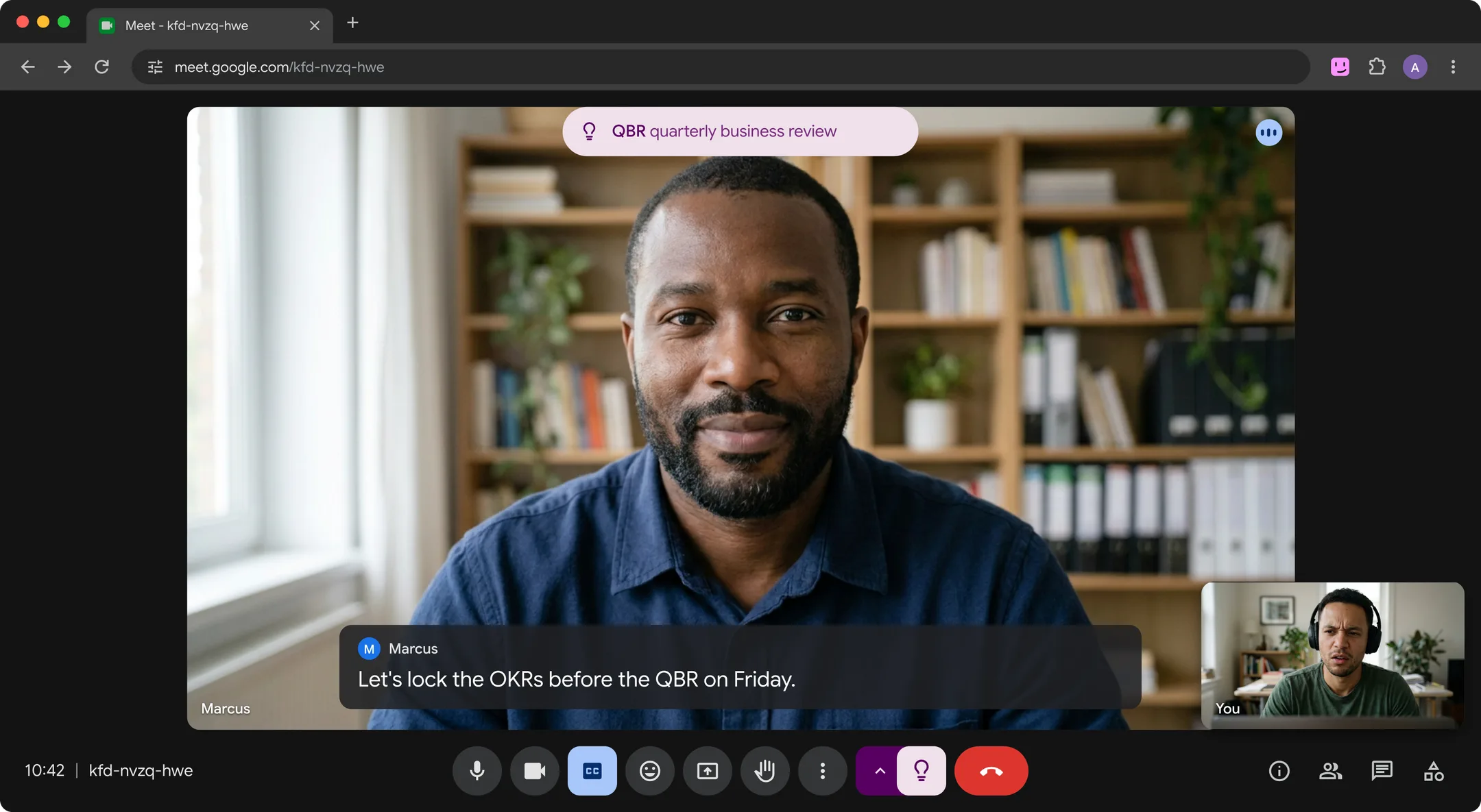
Cards also appear in Meet's Picture-in-Picture window, so they follow you to another tab. It also reminds you who people and projects are when they come up again in the same call.
What it won't do:
- Work outside Google Meet. It runs on Meet calls in desktop Chrome only, so Zoom, Teams and in-person pitches aren't covered.
- Explain everything. It sticks to named terms and skips everyday words, idioms and casual phrases.
- Replace advice. Hints are written by AI and can be wrong. A one-line explanation is no substitute for a lawyer reading your term sheet.
- Take notes. No bot joins, and nothing is recorded, transcribed or summarized. If you need notes, see Google Meet AI assistants.
- Translate. It's built for calls in English.
Caption text, including what everyone else on the call says, is sent to Hintly's server and AI models to write the hints, and the server doesn't store it. Investor and board calls can be sensitive, so check your company's policy on AI tools first. Your first 60 minutes of call time are free, then Pro is $12 a month for 50 hours of calls.
For more vocabulary, see AI terms explained and how to keep up with acronyms at work.
FAQ
What's the difference between pre-money and post-money valuation?
Pre-money is the valuation before a new investment, and post-money adds the new money. $2 million invested at an $8 million pre-money makes a $10 million post-money, and the investors own 20%. On YC's post-money SAFE, the cap is a post-money figure, so investment divided by cap gives the investor's ownership before the next priced round.
What is a SAFE?
A simple agreement for future equity: money now for the right to shares later, usually at the next priced round. Y Combinator created it in 2013. It isn't a loan, so there's no interest or repayment date. YC's standard post-money SAFE comes with a valuation cap, a discount, or neither (an "uncapped MFN" version), and the forms are free on YC's documents page.
What does "default alive" mean?
It's Paul Graham's phrase for a startup that will reach profitability on the cash it already has, assuming costs stay flat and revenue keeps growing at its recent rate. A default dead company runs out of money first unless it raises more or changes course. His advice is to ask the question early, while there's still time to fix the answer.